Wednesday, August 27, 2008

Q and A: Bruschetta

Q: Jenny from Australia asks:


Isn't bruschetta made out of ham??


A: Pronounced "Bru-sket-ta" in Italian and one of the simplest aperitivo snacks, bruschetta is typically slices of crusty toasted bread, drizzled with extra virgin olive oil and rubbed with seasoning, usually garlic. Then come the toppings which area as varied as regional Italian cuisine.


The most classic bruschetta is topped with chopped tomatoes, marinated in extra virgin olive oil, lemon juice, salt, pepper, garlic (and sometimes basil or oregano). But Bruschetta can also be topped with ham. I recommend Prosciutto di Parma.


I've even had bruschetta with lard, pâté, and my own concoction of pesto and fresh mozzarella which was a big hit with my Italian dinner guests.


If you're short for time and need a quick but satisfying first course, bruschetta is the perfect choice and pretty impossible to mess up. Just don't skimp on the extra virgin olive oil. Dry bruschetta is hard to bite through and not very flavorful.


Buon Appetito!

Northern Hospitality

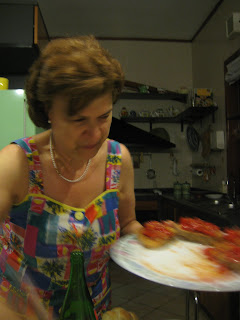
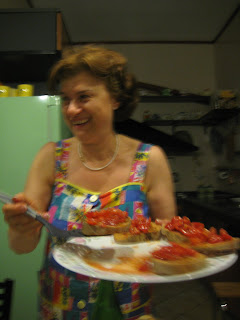
Just in case you were doubting how the Northerners get down in Italy, here's a sample of a dinner party that I was invited to at an agriturismo outside Treviso. The lady with the poofy red hair has possibly the best laugh I've ever heard and the evening was a general circus of outrageous activity including magic tricks, rapping and a conga line into the kitchen (that was quickly vetoed by chef).

Saturday, August 9, 2008

Southern Hospitality

It was quittin' time. Six o'clock on Friday evening. Grazzanize would soon be a distant but no less disturbing memory and a new Italian city would be circled on the map. I had experienced the worst of southern Italy in Grazzanise, although I can safely say there are places even more dangerous near Napoli Centrale and the port. But little did I know that I was about to experience the best of Southern Italy only a few hours later.

As Friday wound down my Scottish friend, Lynne, and I frantically planned our sleeping arrangements for the next four days while simultaneously orchestrating a final performance with the Camorra Kids. No small feat. Neither of us were working the following week; I was awaiting the arrival of my mother from New York and Lynne was recharging her batteries after the grueling week we'd just had. We texted friends and families spanning as far north as Tuscany and as far south as Siracusa hoping that someone would open their doors to us. One by one each potential possibility fell through, the clock struck eight, the final trains to Sicily and Florence left and we were still in Grazzanise.

Lynne, stuck in Grazzanise
Then Lynne's phone rang. It was Anna Maria Carbone, the mother of three wonderful children who we taught two weeks prior in Paestum, near Salerno. She was getting ready to take the family on a two-week holiday at the seaside but was checking up on us (as Italian moms so often do) to make sure we hadn't been taken out by one of our students, and were eating enough vegetables. She sensed something wasn't right and demanded we come to her house in San Gennaro Vesuviano, a suburban town at the base of Mt. Vesuvius.

Twins, Francesca and Federica Carbone

The Carbones dropped everything. They drove to a toll stop to pick us up, gave us plush bath robes for our hot showers and cooked us dinner at eleven o'clock. Anna Maria prepared roasted marinated vegetables, mozzarella di bufala, crusty bread, gelato and gorgeous peaches, even though a Nutella sandwich would have sufficed. The whole family came up to the rooftop terrace to enjoy our midnight snack. We laughed and ate while Mt. Vesuvius calmly watched from behind and the stars winked at us from above, as if to say, "See, this is the real Southern Italy."

Enzo, Anna Maria and Giovanni Carbone enjoying our midnight dinner


View of Mt. Vesuvius

It was the kind of hospitality I'd always imagined I'd find in the south. Mi Casa es Su Casa--literally--they gave us their house. Well they offered us the house while they were on vacation but the responsibility of a gorgeous four-story home and all its relics was too large.

San Giuseppe Vesuviana


So they gave us their apartment in neighboring San Giuseppe Vesuviana. Anna Maria had already called over to her sister who lives above the apartment, made sure we'd be well fed and even arranged our social calendar by alerting her 23-year-old nephew, Andrea, and beautiful 25-year-old family friend, Carla, of our arrival. All before we had finished our morning shot of espresso.


Ana Maria's sister serving us her homemade bruschetta


Carla, Me, Lynne


Andrea enjoying his Mom's home cooking

After 24 hours in San Giuseppe Vesuviana I had met more friends than in my first three months living in Treviso. The kind of friends that make you say, "I feel like we've known each other forever." Fun, warm, and above all, generous. Proud people who wanted us to experience the best of their region. And we did.

Pizza in Pompeii, dancing in Nola, home-cooked meals that rivaled New York City's best rustic Italian restaurants. Carla's mom even did my eyebrows after lunch, and almost lost her lunch when I told her I pay $32 to have the same thing done at Anastasia in NYC.


Carla and her boyfriend of six years, Pepe, promised us that they would show us the "real" Naples, not the one made so infamous in the press. On our final night before parting ways we went into into the heart of Naples' historical center. The moon was full and I noticed the way it chased the car, just like it had when I was a kid. The ground was damp, creating a magical glow in Piazza Plebiscito, Napoli's largest square. One final aperitivo near Castello dell'Ovo gave us a chance to joke and reminisce about the fun times we'd had, like old friends do. As the four of us walked to the car I watched tourists dine at 5-star hotel restaurants, fumble through guide books and buy goofy Italian souvenirs and, as I do so many times in Italy, I felt really lucky.

Friday, August 1, 2008

Camorra's Kids

Grazza sounds like grazie and nise is one letter away from nice. But Grazzanise, a town in the province of Caserta, doesn't inspire nice images or make you feel thankful to be there. You feel like an outsider, all eyes watching you, sizing you up from the window sills above, peeking through the beads hanging in the doorways of the macelleria and panificio. Chatty bar patrons fall silent as you pass, eavesdropping on your conversation and trying to interpret your strange language. But they can't.

In Grazzanise, few speak English. Few speak Italian. Here, they speak dialect. A sloppy, rough-around-the-edges version of Napoletano that sounds as if every word is an accusation or cuss. Here it seems suspicion isn't in the air, it is the air. Here is where I spent a week teaching English to middle school children, many of whom were born into a century-old war of corruption, secrecy and violence. These are the Camorrisiti offspring, the children of La Camorra.
Sicily has the Mafia, Calabria has the 'Ndrangheta and Campania has La Camorra. I hear the term every night on the Italian evening news, when expressionless news reporters update the public on trash fires, protests and the rising stench of Napoli's waste removal crisis, of which Camorra is at the helm.I smelled the stench every morning on the drive to school. Some days burning plastic other days rotting trash thrown from the window of the car and left on the side of the road. And a sharp chemical smell. That was the worst. On one of those rides to school, our project director told us specifics on some of the kids in the program. This boy's uncle is in jail, So and So's father was murdered last year. It all seemed so nonchalant. Like she was giving us the weekly weather forecast. Rain in the east, cloudy up north, murder in the south. At school signs of neglect were everywhere. Broken glass littered the asphalt yard and green mold bubbled from the sink drains in the boys' bathroom. It seemed unthinkable that children would spend their adolescent years here, but the kids and staff didn't seem to notice. Numb to it, I guess. Hardened like blobs of chewing gum stuck on the desks.
There are drastic differences in the kids here from the kids I worked with two weeks before in the affluent Sorrentine Penninsula, only a couple of hours away. Grazzanise kids are fighters, if they want to do something they do it, no regard to rules. They shattered the window pictured below with a ball, defaced a girl's doll with swastikas, and spit, in food and in faces. They were expert thieves stashing the materials they stole from us in their pockets, shoes and mouths and then turning on a charming smile when confronted about it. Lying came too easily for them.
I'd be lying if I said I didn't hate these children at first. They invite you to hate them and seem more comfortable having enemies than friends. But when you sit down one-on-one with them, away from the pressure of the group it's clear that the attitude is all a front. A "tough guy" exterior with an attention-starved baby inside.

During the forty hours I spent with these kids there were a few beautiful moments when I'd capture them with a cheerful song, an interesting lesson, or a friendly competition. For those brief minutes you saw a sparkle in their eye, a scowl turn to a smile, a puffed up chest deflate. For those few minutes you saw the thing most precious in a child's life but so rare in these kids' world. Innocence.


For further reading on the Camorra check out Robert Saviano's Italian best-seller, Gomorrah.